Sunday, September 28, 2008

Romare Bearden


The artist I have chosen as our September artist is Romare Bearden. He was born on September 2, 1911, in Charlotte, North Carolina, and died in New York City on March 12, 1988, at the age of 76. When he was young, his family moved to Harlem in New York City. Here he learned to appreciate jazz music. He experimented with many different mediums but is best known for his collages. Collages are pictures or designs created by pasting flat elements such as newspaper, wallpaper, printed text, illustrations, photographs, cloth, string, and painted or drawn pictures to a flat surface.
The Metropolitian Museum of Art has a great Interactive Romare Bearden Page called "Let's Walk the Block". Here you can learn about the artist, the history and inspiration behind "The Block", and examine this large scale collage more closely. You can also follow the directions to make your own collage about your own neighborhood.
If you want a quick preview of Romare Bearden's life and works click here.
At the MOMA you can watch a short video showing Romare Bearden discussing how he came up with his ideas and created his collages and paintings. Just click on:
Romare Bearden.

Sunday, August 31, 2008

Andy Warhol


I have chosen Pennsylvania born Pop artist, Andy Warhol, as my choice for August.

He was born Andrew Warhola, August 6, 1928, in Pittsburgh, Pennsylvania. He is best known for his exploration of Pop Art, an art movement that emerged in America and elsewhere in the 1950s to become prominent over the next two decades.


This art period mass produced images of mass produced objects. Pop artists focused their attention on familiar images of the popular culture such as billboards, comic strips, magazine advertisements, famous people, and supermarket products.

Some of his most famous works depicted Campbell's soup cans. These were enlarged, hand-painted or silkscreened, framed, and hung in art galleries.


Andy Warhol died in 1987 after establishing himself as the most well known Pop artist. If you want to see how the silkscreen process works or try and create a Pop art e-card, click on POP ART.

Thursday, July 31, 2008

Alexander Calder


Alexander Calder is the artist I picked for our July birthday artist. There were many artists born in July, but Sandy Calder is no doubt, my favorite. He was born in Lawnton, Pennsylvania (that’s close to Philadelphia) on July 22, 1898. His father and grandfather were both sculptors. Calder’s mother was also a professional portrait painter.

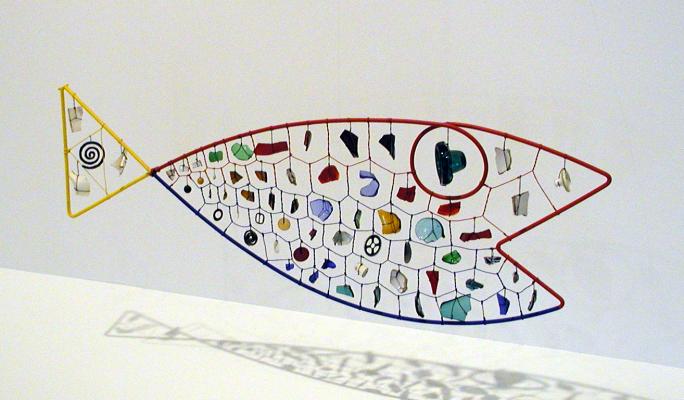
Calder also became a sculptor. Kinetic sculpture probably describes his works the best. Kinetic sculptures are sculptures that actually move in space. Calder created stabiles and mobiles (his first in 1932). He also designed and built large public sculptures. He was 76 when he died on November 11, 1976.

Click on the following words to better understand and view some of Calder’s works.

Definitions of Mobile, Sculpture, and Stabile

The Circus

Fish

Object with Red Ball

The Crab

I think using some found objects you could very easily make a stabile or mobile. Just some string, wire, foam, beads, paper, whatever and you are a sculptor too. Sandy Calder made his parents a kinetic sculpture when he was in 4th grade. I hope you will give it a try.

Sunday, June 29, 2008

Frank Lloyd Wright


My selection for my June artist is an American architect. I think you will enjoy learning about one of his buildings. Frank Lloyd Wright was an American architect, interior designer, writer, and educator who was born June 8, 1867 at Richland Center, Wisconsin. He died on April 9, 1959 at the age of 91. I have always been interested in architecture. It is the art and science of designing and building structures within spaces.

My most favorite Wright piece of architecture is classified as organic architecture. Organic architecture is when the architect designs the building within the natural surroundings so both work together to create the total composition. In today’s world that is a beautiful philosophy. The building is called Fallingwater and is located in Mill Run, Pennsylvania. Fallingwater is in the southwest Pennsylvania’s Laurel Highlands southeast of Pittsburgh. To take a short virtual tour of this magnificent structure click here.

Well-known during his own lifetime, Frank Lloyd Wright was recognized in 1991 by the American Institute of Architects as "the greatest American architect of all time.” I hope you loved Fallingwater as much as I do and go visit it soon.

Thursday, May 15, 2008

Color


I think it is time we discuss color.
Color is one of the best art elements in our world. I love color. My favorite color is green. What is your favorite color?

How we create color and see color is quite different in art, science, and the printed page.
Let's explore color.

Click here for an understanding of color by my friend the colorworm.
To learn even more about color theory, click here.

Our May artist of the month is Keith Haring. He is another Pennsylvania born artist for you to get to know better. He was born on May 4th, 1958, in Reading, Pennsylvania. The Haring family lived in Kutztown, a nearby Pennsylvania Dutch farm community, where Keith was raised. I think you will like his art work. You can learn all about Keith and see his art work when you click on haringkids. Have fun and let me know what you think. Here is a picture of Keith Haring working on a mural. He also did sculptures as well as paintings.

Wednesday, April 30, 2008

Leonardo Da Vinci


Our April Artist of the month is Leonardo Da Vinci.

He was born on April 15, 1452 and died on May 2,1519 in a region of Florence, Italy. He was an Italian artist, scientist, engineer, mathematician, inventor, anatomist, painter, sculptor, architect, botanist, musician, and writer. Today he is considered an all-round genius whose paintings and inventions changed the world. Two of his works, the Mona Lisa and The Last Supper are his most famous, most reproduced, paintings of all time. Click on either to learn more about each. Click on 10 questions about The Last Supper to learn more about it.

Leonardo Da Vinci is described as a Renaissance Man. This term means a person who is well educated, or who excels, in a wide variety of subjects. The Renaissance was a rebirth or revival of cultural awareness and learning. It took place during the 14th and 15th centuries in Italy, Germany and other European countries. There was a renewed interest in ancient Greek and Roman art and design. The focus was on human beings, the environment, science, and philosophy.

If you want to try a timed two minute puzzle on the Mona Lisa click here. It took me a couple of times to get it completed on time. Try your skills.

Wednesday, April 9, 2008

Scherenschnitte? What is it?


Let's explore a specific PA German folk art that has been passed down from generation to generation. Yes, after exploring you can create a Scherenschnitte folk art piece too. Just follow the directions and you can create a beautiful 'one of a kind' snowflake.

1. What is Scherenschnitte?
2. What do I need to make a Scherenschnitte snowflake?
3. Make sure you start with a square of paper. It doesn’t matter what size, as long as it is a square. I like to use copy paper.
4. How should I fold the paper so I can make a six sided snowflake?
5. What shall I draw on my paper?
6. Am I ready to cut my snowflake?
7. What does the snowflake look like?
8. Are you ready to practice making a snowflake? Let’s practice here first.
9. Need some ideas before you start?

Now I think you are ready to actually get your tools and materials together and make a paper snowflake. You can go back and follow each step as you create your Scherenschnitte snowflake. Have fun. If you have any questions along the way, you can email me, comment here, or go to the Linntown Art Place wiki.

10.If you want to see the entire process to make a six sided Scherenschnitte snowflake, just watch the video below.